The Colosseum Audio Guide
Built on an emperor's lake, opened with 100 days of games, and still standing after 1,900 years. Six illustrated chapters, about 12 minutes. Pick your narrator.
Full transcript
Tap any sentence to jump there. Switch tone above to read that version.
Storyteller tone · 12:06 · voice: en-GB-RyanNeural
Chapter 1: An Arena Built on an Emperor's Lake
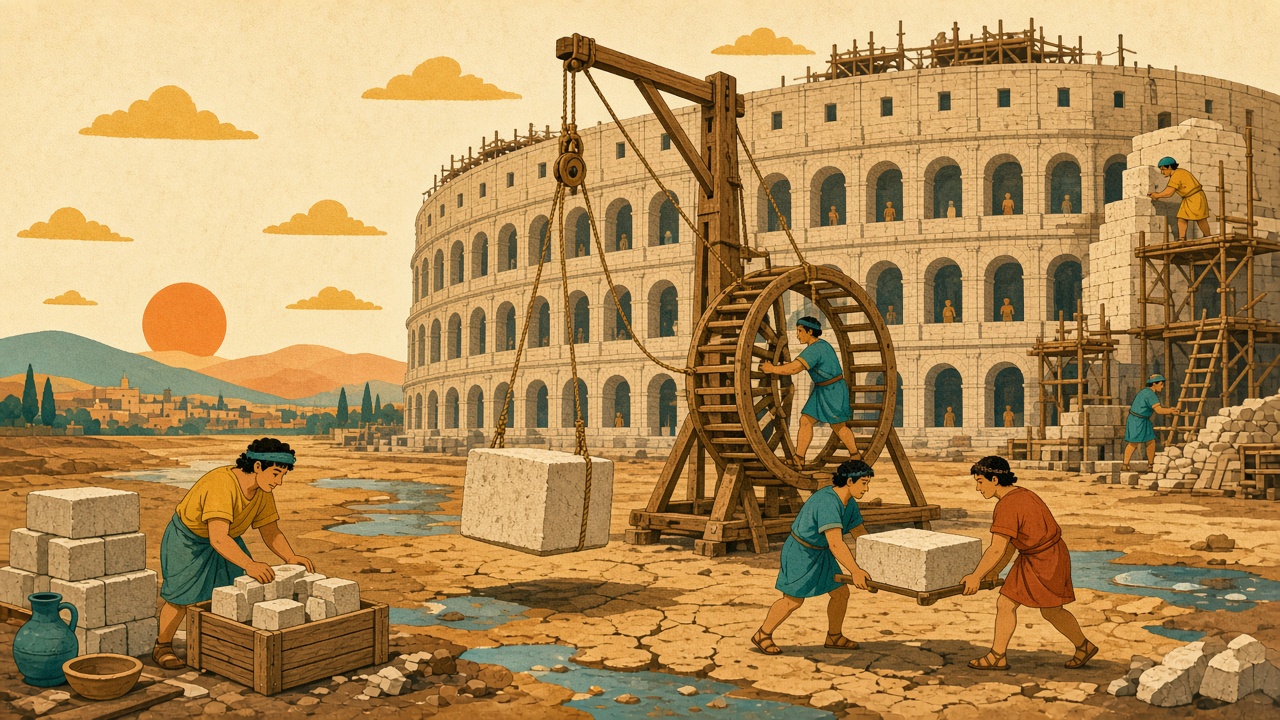
Imagine Rome in the summer of AD 64. A fire breaks out near the Circus Maximus and rages for days, devouring whole neighborhoods. When the smoke clears, the emperor Nero claims a vast stretch of the ruined heart of the city for himself. There he builds the Domus Aurea, the Golden House: halls glittering with gold and gems, gardens and vineyards, and, in the valley where you now stand, a shining artificial lake. Beside it rises a colossal bronze statue of Nero himself. Four years later, Nero is dead, and the empire is torn by civil war. Out of the chaos rises a seasoned soldier named Vespasian. He understands something Nero never did: that power must be shared, at least in appearance, with the people. And so, around AD 70 to 72, he drains Nero's lake and on its bed begins to build an amphitheatre for the citizens of Rome. The tyrant's private pleasure becomes a public gift. The cost was immense. Many historians believe the construction was funded, at least in part, by treasure seized when Roman legions captured Jerusalem in AD 70, and that much of the labor came from prisoners of that war. Every block carries that memory. The building rose in travertine stone, tuff, brick and concrete, its stones bound by iron clamps. Its official name was the Flavian Amphitheatre, after Vespasian's family. The name we use today, Colosseum, came later, perhaps borrowed from the colossal statue of Nero that still stood nearby. History has a sense of irony: the emperor's statue vanished, but its name lives on in the building meant to erase his memory. Vespasian did not see his amphitheatre finished. He died in AD 79. It fell to his son, Titus, to open its gates, and when he did, the celebrations lasted not a day, not a week, but one hundred days.
Chapter 2: One Hundred Days of Games
It is the year AD 80. The new amphitheatre gleams in the sun. Crowds pour through its arches, and the emperor Titus opens a festival of games that, ancient writers tell us, ran for one hundred days. There were hunts, called venationes, in which beasts from the edges of the known world were brought to fight or be killed. There were public executions, a grim part of Roman life. And there were gladiators. The historian Cassius Dio, writing more than a century later, claimed that nine thousand animals died during these opening games. Ancient figures were often inflated, so we should hold that number lightly. Yet it hints at a spectacle on a scale the city had never seen. Some ancient accounts even describe the arena flooded for staged naval battles in those early years. Historians still debate where and how such shows took place. But the story tells us how Romans wanted to remember these games: as something impossible made real. How many people filled the stands? Most estimates suggest around fifty thousand, perhaps more. To move such a crowd, the architects gave the building eighty arches at ground level. Look above them, and you can still see Roman numerals carved into the stone: gate numbers, matching the tokens spectators carried. Entrance was usually free, a gift from the emperor or the wealthy sponsor of the games, for in Rome, generosity was a form of power. At the four main points of the compass, the grand entrances carried no numbers. They were reserved for the emperor, for officials, and for the performers who would walk out onto the sand. And so the crowds climbed the stairways and spread through the tiers. But no Roman simply chose a seat. In this building, where you sat told everyone exactly who you were. Let us climb, and find your place.
Chapter 3: Your Seat Depends on Who You Are
Climb, and the arena opens beneath you. From here you can see how the Colosseum was not only a stadium, but a map of Roman society, drawn in stone. Closest to the arena, on a raised terrace, sat the senators in their white togas edged with purple. The emperor watched from his own box. Behind and above them came the knights, the wealthy equestrian class, then the ordinary citizens, divided further by status. Soldiers had their own places. Boys sat with their tutors. And at the very top, highest and farthest from the action, sat the poor, and, as most historians believe, the women. Now lift your eyes to the rim of the outer wall. You can see stone brackets and sockets. Once, wooden masts rose from them, holding the velarium, a vast awning that could shade the crowd from the burning Roman sun. Ancient sources tell us it was worked by sailors of the imperial fleet stationed at Misenum, on the Bay of Naples, men who understood rope, canvas and wind. Exactly how the great sail was rigged remains a puzzle that engineers still argue over. The Romans thought of comfort, too. There were fountains for drinking water and latrines for the crowds. In the drains, archaeologists have found the remains of what spectators ate: olives, nuts, fruit, bits of meat. A day at the games was a day out, with food, friends and noise. Pause here and imagine the sound. Fifty thousand voices. Trumpets. The roar rising and falling like waves, and the sails above flapping in the wind. And now look down at the arena, to the place where the gladiators fought. We think we know them: the thumbs, the fights to the death, the muscle-bound warriors. But the truth, as the bones of real gladiators reveal, is stranger.
Chapter 4: Gladiators: Myths vs Reality
Let us meet the gladiators as they really were. They trained in schools called ludi. The largest, the Ludus Magnus, lay just beside the Colosseum, and you can still see its curved ruins from the street. Training took years, and a skilled fighter represented a great investment for his owner. So, contrary to legend, not every bout ended in death. A beaten gladiator could appeal for mercy, and the sponsor of the games, often listening to the crowd, could grant it. Death came often enough. But it was not the rule. And the famous gesture? Ancient writers mention a turned thumb, but which way meant life and which meant death, we simply do not know. The image of a thumb pointing down owes much to a painting from the nineteenth century, and to the films that followed. Their bodies tell a surprising story too. Ancient writers called them hordearii, barley men. And when scientists studied skeletons from a gladiator cemetery at Ephesus, in what is now Turkey, they found evidence of a diet rich in grains and beans, and perhaps a drink made with plant ash, possibly to strengthen their bones. These were not feasting warriors, but athletes on a careful, humble diet. They fought in types, each with its own weapons. The retiarius, nearly unarmored, carried a net and a trident, relying on speed. The murmillo wore a heavy helmet and bore a sword and a tall shield. Pairings were planned for drama: agility against strength. Most were enslaved people, prisoners of war or condemned men. Yet some free men chose this life, chasing money and glory, and a few became stars, their names scratched on walls by admirers. Now lean forward and look down, below where the arena floor once lay. A labyrinth of stone corridors stretches out in the shadows. Here, hidden from the crowd, the true machinery of the spectacle waited.
Chapter 5: Lifts, Trapdoors, and Lions
Below you lies the hypogeum, from the Greek for underground. Once, a wooden floor covered it, strewn with sand. The Latin word for sand was harena, and from it comes our word arena. The hypogeum was built under the emperor Domitian, Titus's younger brother, after the amphitheatre had opened. It was the hidden heart of the show: two levels of tunnels, chambers and cages, where hundreds of workers moved in near darkness while the crowd roared overhead. And here was the magic. Wooden lifts, powered by men turning capstans and balanced with counterweights, carried animals, fighters and scenery up toward trapdoors in the arena floor. In an instant, a lion could appear from the sand. A whole landscape of rocks and trees could rise from nowhere. In 2015, a team built a working replica of one of these lifts in the hypogeum, a glimpse of the ancient trick brought back to life. The animals came from across the empire and beyond its borders: lions and leopards, bears and bulls, ostriches, and, ancient writers tell us, even elephants and rhinoceroses. Most of them died on the sand above. It is a part of this place that asks us to look honestly at what entertainment once meant. If you have a special ticket, you may walk these underground corridors yourself, or stand upon the rebuilt part of the arena floor, gazing up at the tiers as a gladiator once did. These tickets are limited, so they are worth booking early. Stay a moment. Listen to the silence where once there were creaking ropes, growling animals and shouting men. Then come with me outside. For when you walk around the Colosseum, you will notice that a part of it is simply gone, and that its surviving walls are pitted with holes, as if something had been taken from inside the stone itself.
Chapter 6: Earthquakes, Quarries, and Your Visit
Step back and look at the Colosseum whole. On one side, the outer ring rises to its full height. On the other, it falls away. What brought it down? Time, and the earth itself. Earthquakes struck Rome over the centuries, and a great one in 1349 toppled much of the southern side. Then came the people. For hundreds of years, the ruined amphitheatre served as a quarry. Its travertine was carted off to build churches and palaces across the city, and tradition holds that some found its way into buildings such as Saint Peter's. The Colosseum did not just stand in Rome. It became part of Rome. And the holes? Remember the iron clamps that bound its stones. In the Middle Ages, iron was precious, and people chiseled into the walls to pry it loose, leaving the scars you see today. The last gladiator combats were likely held early in the fifth century, and the animal hunts faded a century later. Afterwards, the building lived many lives: homes and workshops in its arches, a stronghold for a noble family, and a wild garden so rich in plants that botanists catalogued hundreds of species growing among the stones. In 1749, Pope Benedict the Fourteenth consecrated the Colosseum to the memory of Christian martyrs. There is, in fact, no firm evidence that Christians were martyred here, though many people surely died on its sand. But the dedication helped protect the building from further plunder, and so, perhaps, it saved what remained. In 2007 it was voted one of the New Seven Wonders of the World. For your visit: book a timed ticket through the official site, colosseo dot i t. The standard ticket was eighteen euros at our last check and includes the Roman Forum and Palatine Hill. Come early or late in the day, bring water, and take your time. Thank you for walking with me through the Colosseum. In another city, another story awaits.
Funny tone · 11:12 · voice: en-US-AndrewNeural
Chapter 1: An Arena Built on an Emperor's Lake
Here's a fun fact to start. The most famous arena in the world was built on top of a rich guy's private lake. Like building a stadium in someone's backyard pool. Hi, I'm your funny friend for the next twelve minutes, and we're doing the Colosseum the fun way: six stops, no homework, maybe one lion. So. Rome, the year AD 64. A huge fire burns a big part of the city. Emperor Nero, who was not exactly famous for good decisions, then builds himself an enormous new palace complex called the Domus Aurea, the Golden House, with gardens, pavilions and, right about where you're standing, an artificial lake. A giant bronze statue of Nero himself stood nearby. Subtle. A few years later, Nero was gone, Rome had a messy civil war, and a tough, practical general named Vespasian became emperor. And Vespasian made a very smart PR move. He drained Nero's private lake and, around AD 70 to 72, started building a giant amphitheatre for the people right on that spot. Message: the emperor's private playground is now your playground. Very good marketing. How was it paid for? Most historians think it was funded, at least partly, with treasure taken after the Roman army captured Jerusalem in AD 70, and many of the workers were probably enslaved prisoners from that war. Not a happy story, but an important one. The official name was the Flavian Amphitheatre, after Vespasian's family. The name Colosseum came later, and the most popular theory is that it came from that colossal statue of Nero standing next door. So in a way, Nero got the last laugh. His statue is gone, but its nickname is on every postcard. It's made mostly of travertine stone, plus tuff, brick and concrete, held together in part by iron clamps. Remember those clamps. They come back later, in a weird way. Vespasian didn't live to see it finished. He died in AD 79. So it was his son Titus who got to throw the opening party. And what a party. It lasted one hundred days. Next stop.
Chapter 2: One Hundred Days of Games
Picture opening day, AD 80. Emperor Titus opens the amphitheatre with games that, according to ancient writers, went on for one hundred days. One hundred days! Most of us can't get through a long weekend without needing a nap. What happened during those games? Animal hunts, called venationes, with exotic animals from across the empire. Executions of criminals, which were part of public life back then, unfortunately. And gladiator fights. Ancient historian Cassius Dio, writing more than a century later, claimed that nine thousand animals were killed during the opening games. Ancient numbers were sometimes, let's say, enthusiastic, so treat that as a big round brag rather than a careful count. But it was clearly a lot. Some ancient sources even say the arena was flooded for mock sea battles in the early years. Historians argue about whether that really happened here or somewhere else, and how. Flooding a stadium is not easy. But Romans loved a big show, and they were very good engineers, so who knows. How many people came? Estimates usually land around fifty thousand spectators, sometimes higher. That's like a modern football stadium. And the Romans moved those crowds in and out with eighty entrance arches around the ground floor. You can still see numbers carved above many of them. Look up. There's a Roman numeral. That's the gate number on your ticket. Yes, tickets. They were usually free, handed out by the people paying for the games, often the emperor himself, because nothing makes people like you more than free entertainment. Ancient Rome's version of a politician handing out free concert tickets. Fun detail: the four entrances in the middle of each side were special, without numbers. Those were for the emperor, important officials and the performers. Okay, so you've got your free ticket and your gate number. But here's the catch. Where you sat had nothing to do with when you arrived. It depended entirely on who you were. Let's go find your seat.
Chapter 3: Your Seat Depends on Who You Are
Welcome to the upper levels. Look around, because this is where the Roman social pyramid becomes very literal. In the Colosseum, seating was organized by class. At the bottom, closest to the action, on a raised platform, sat senators, in their white togas with purple stripes, and the emperor in his special box. Then came wealthy knights, then ordinary Roman citizens, with different sections for different groups. Soldiers had their own area. Young boys sat with their teachers. And at the very top, in the cheap seats, sat the poorest people, and, according to most historians, women, way up in the nosebleed section. So if you were a senator, you got a front-row seat. If you were a regular citizen, you got a decent view. And if you were at the top, you got fresh air and binoculars that hadn't been invented yet. Now look up at the top edge of the wall. See those stone brackets and holes? They held wooden poles for a giant awning called the velarium, made of fabric stretched over the seats to give shade. And who operated this enormous sun shade? Sailors. Specifically, sailors from the Roman fleet based at Misenum, near Naples. Why sailors? Because if you can handle ropes and sails on a warship, you can handle the world's biggest beach umbrella. Exactly how it worked is still debated, but the sailors part comes from ancient sources. Also, there were water fountains and even toilets. The Romans were serious about crowd comfort. A Roman stadium probably had better facilities than some modern music festivals. Spectators brought snacks, too. Archaeologists found remains of foods like olives, nuts, fruit and meat in the drains. So basically, it was a sports stadium with picnic food. Now, from your seat, look down at the arena. This is where the gladiators fought. And everything you think you know about gladiators, from the thumbs to the diet to the fights to the death, might be a little bit wrong. Let's find out.
Chapter 4: Gladiators: Myths vs Reality
Okay, gladiators. Let's do myth versus reality. Myth number one: every fight ended in death. Reality: not necessarily. Gladiators were expensive. They trained for years in gladiator schools, like the Ludus Magnus, whose ruins you can see right next to the Colosseum. Their owners didn't want their investment dying every week. Many fights ended with one fighter giving up, and the person running the games could decide to spare him. Gladiators did die, sometimes often, but it wasn't automatic. Myth number two: thumbs down meant death, thumbs up meant live. Reality: we're honestly not sure. Ancient writers mention a thumb gesture, but nobody knows exactly which way meant what. The famous thumbs-down image mostly comes from a nineteenth-century painting. Hollywood did the rest. Myth number three: gladiators were giant beefy steak eaters. Reality: they ate mostly barley and beans. Ancient writers called them hordearii, which roughly means barley men. And a study of skeletons from a gladiator cemetery in Ephesus, in modern Turkey, suggests they ate a mostly plant-based diet, and may have drunk a kind of plant-ash drink, possibly for their bones. So gladiators were, kind of, early vegetarian athletes. Somebody tell the protein shake companies. Gladiators came in types, like characters in a video game. The retiarius fought with a net and a trident, almost no armor. The murmillo had a big helmet, a sword and a large shield. They were often matched against each other, fast versus strong. Who were they? Mostly enslaved people, prisoners of war or criminals, but some were free men who signed up for money and fame. A few became celebrities, with fans scratching their names on walls. Now look down into that maze of walls below the arena floor. That's where the real magic of the shows happened. Trapdoors, elevators, and lions popping up out of nowhere. Let's go underground.
Chapter 5: Lifts, Trapdoors, and Lions
Look down. That maze of stone walls where the arena floor used to be is called the hypogeum, which basically means underground. Originally, there was a wooden floor covered with sand on top of it. The word arena actually comes from the Latin word for sand, harena. So when you say arena, you're technically saying sandbox. The hypogeum was added under Emperor Domitian, Titus's younger brother, a few years after the opening. It was the backstage of the Colosseum. Two levels of tunnels, rooms and cages, with hundreds of workers running around during the shows. Here's the coolest part. There were lifts. Wooden elevators, powered by people turning big capstans, with ropes and counterweights, that could lift animals, scenery or fighters up to trapdoors in the arena floor. So in the middle of a show, suddenly, a lion pops up out of the ground. Or a whole set with trees and rocks appears. Special effects, Roman style. In 2015, a team actually built a working replica of one of these lifts and used it to lift an animal into the arena, a wolf in a cage, as a test. The wolf was reportedly unimpressed. Animals were brought from all over the empire and beyond: lions, leopards, bears, bulls, ostriches, even elephants and the occasional hippo or rhino, according to ancient writers. Many of them died in the shows. It's a part of the history that's hard to hear about today. Tip: some tours let you go down into the hypogeum or stand on a rebuilt section of the arena floor. Those need special tickets, so book early. Standing where the gladiators stood is wild. Okay. One last mystery. Walk around the outside and you'll notice something strange. Part of the outer wall is just missing. And the walls are full of little holes, like a giant took a bite of Swiss cheese. Was it war? Was it time? Was it someone stealing stuff? Spoiler: yes. Last stop.
Chapter 6: Earthquakes, Quarries, and Your Visit
Walk outside and look at the Colosseum from a distance. On one side the tall outer wall still stands. On the other side, it's missing. What happened? First, earthquakes. Several hit Rome over the centuries, and a big one in 1349 brought down a large part of the southern side. Second, recycling. For centuries, the Colosseum was basically Rome's free stone supply. People carted away stone to build churches, palaces and other buildings across the city. It's often said that stone from here ended up in famous buildings like parts of Saint Peter's. So if you visit other monuments in Rome, you might be looking at bits of Colosseum. Upcycling, medieval style. And the holes? Remember the iron clamps? Iron was valuable, so in the Middle Ages people chiseled into the stone to pull them out. That left the walls full of holes. The building literally got its metal pickpocketed. The last gladiator fights were probably held in the early fifth century, and animal hunts continued for about another century. After that, the Colosseum became housing, workshops, a fortress for a powerful family, and even had a garden full of wild plants that botanists wrote books about. In 1749, Pope Benedict the Fourteenth dedicated it to Christian martyrs. Interesting twist: there isn't solid evidence that Christians were actually killed here, though it's very possible people were executed here for many reasons. The pope's dedication helped protect the building from more stone stealing, so, thanks, pope. In 2007, the Colosseum was named one of the New Seven Wonders of the World in a big public vote. Your game plan: book a timed ticket on the official site, colosseo dot i t. The standard ticket was eighteen euros at our last check and covers the Roman Forum and Palatine Hill too. Go early or late, bring water, and wear good shoes. That's the Colosseum! Thanks for hanging out with me. See you in the next city.
Family 7+ tone · 10:57 · voice: en-US-AvaNeural
Chapter 1: An Arena Built on an Emperor's Lake
Hey explorers! Welcome to the Colosseum in Rome, Italy. It's almost two thousand years old, and it's one of the most famous buildings in the whole world. Your mission today: find a gate number, a sailor's secret, a gladiator's lunch, and a lion elevator. Ready? Let's go! Here's a surprising fact. The Colosseum was built where a lake used to be! A long, long time ago, there was an emperor named Nero. An emperor is like a super-powerful king. Nero built himself a giant palace called the Golden House, with gardens and a big pretend lake, right about where you're standing now. Next to it was a giant statue of, guess who? Nero himself! After Nero, a new emperor named Vespasian came along. He wanted the people of Rome to like him. So he said, let's drain that lake and build a giant stadium where everyone can come and watch shows! People loved that idea. Building started around the year 70. It took about ten years, which is less time than you might think for something so huge. Lots of workers built it, and many of them were prisoners who were forced to work, which is a sad part of the story. Mission time! Look at the big outside wall. Can you count how many floors, or levels, it has? Hint: look at the rows of arches. Tell your grown-up your answer. The real name was the Flavian Amphitheatre. But people started calling it the Colosseum, maybe because of Nero's colossal statue next door. Colossal means really, really big. So the name means something like the giant one. Pretty good name! Emperor Vespasian didn't get to see it finished. His son, Titus, was the one who opened it. And when he did, he threw a party with shows that lasted one hundred days! Can you imagine a party that long? Let's find out what happened.
Chapter 2: One Hundred Days of Games
Welcome inside! Imagine it's the year 80. Emperor Titus is opening the Colosseum, and the shows go on for one hundred days. That's more than three months! What kind of shows? There were wild animals brought from faraway lands, like lions, bears and ostriches. There were fighters called gladiators. A writer from long ago said thousands of animals were in the shows. Writers back then sometimes made numbers bigger to sound impressive, so we're not sure of the exact number. Sadly, lots of the animals got hurt. People today think very differently about treating animals, and that's a good thing. How many people could fit inside? Around fifty thousand! That's like a giant football stadium today. Imagine all those people cheering at once. Can you do a quiet cheer, like a whisper roar? Try it! Mission time! Go to one of the arches on the ground floor and look up above it. Do you see some letters carved in the stone, like an X, a V or an I? Those are Roman numbers! They were gate numbers. Each person got a ticket that told them which gate to use, just like at a stadium today. Can you read the number on your arch? Ask your grown-up to help. And guess what? Tickets were usually free! The emperor or another rich person paid for the shows, because they wanted everyone to like them. There were also four special gates with no numbers. Those were only for the emperor, important people, and the performers. So, you walked in through your gate. Now, where do you sit? Can you sit anywhere you want? Nope! In the Colosseum, where you sat depended on who you were. And there's a secret about a giant sun umbrella too. Let's climb up and see!
Chapter 3: Your Seat Depends on Who You Are
Welcome to the upper levels! Look down at all the rows of seats. Long ago, different people sat in different places. Right at the bottom, closest to the action, sat the most important people, the senators, and the emperor had his own special box. Then came rich people, then regular people. And way up at the very top, the farthest from the show, sat poor people and, most experts think, women and girls. Doesn't seem very fair, does it? Today we think everyone should be treated the same. Now, here's the sailor's secret. Look up at the top of the wall. See the stone bumps and holes? Long ago, tall wooden poles stood there, holding up a giant cloth roof called a velarium. It was like a huge sun umbrella to keep people cool on hot days! And who opened and closed it? Sailors! Real sailors from the Roman navy. Sailors were great with ropes and sails, so they were perfect for the job. Pretty clever, right? Mission: pretend you're a sailor pulling the giant rope to open the sun umbrella. Pull, pull, pull! Heave-ho! The Romans also had water fountains and toilets for the crowd. And people brought snacks! Scientists found leftovers of olives, nuts, fruit and meat in the old drains. So people munched snacks while they watched, just like popcorn at the movies! Mission: if you were going to the Colosseum, what snack would you bring? Tell your grown-up! Now, look down at the middle. That's where the gladiators fought. But wait. Lots of things people believe about gladiators aren't true! Like what they ate for lunch. Do you think it was big steaks? Let's find out!
Chapter 4: Gladiators: Myths vs Reality
Let's play gladiator true or false! True or false: gladiators ate lots of meat to get strong. False! Gladiators ate mostly barley, which is a grain, and beans. People even called them barley men! Scientists who studied gladiator bones found they ate lots of plants. So eat your veggies, little gladiators! True or false: gladiators always fought until one of them died. False! Gladiators trained for a long time in special schools. In fact, the biggest gladiator school was right next door. You can see what's left of it near the Colosseum. Lots of fights ended when one gladiator gave up, and the person in charge could decide to let him go. Sometimes gladiators did die, which is very sad. But not every time. True or false: thumbs down meant a gladiator lost, and thumbs up meant he was saved. Hmm. We don't actually know! Old writings talk about a thumb sign, but nobody is sure which way meant what. The thumbs-down idea mostly came from a painting made much later. Gladiators had different types, like teams in a game. One kind, called a retiarius, fought with a net and a three-pointed spear called a trident, and wore almost no armor. Another, called a murmillo, had a big helmet with a fish shape, a sword and a big shield. Mission time! Which gladiator would you be? The fast one with the net, or the strong one with the big shield? Show your grown-up your best gladiator pose! Most gladiators didn't choose to fight. Many were prisoners or enslaved people. But a few became famous, like sports stars, and fans even scratched their names on walls. Now look down into the middle. See that maze of walls underneath? That was a secret world under the floor, with tunnels, cages, and elevators for lions! Let's go see.
Chapter 5: Lifts, Trapdoors, and Lions
Look down into the middle! That maze of walls is called the hypogeum. That's a fancy word that means underground. Long ago, there was a wooden floor on top, covered in sand. In fact, the word arena comes from the old Roman word for sand! Underneath the floor was a secret world. Two floors of tunnels, rooms and animal cages, with lots of workers rushing around during the shows. And here's the coolest part. They had elevators! Wooden elevators, pulled up by ropes, with workers turning big wheels. The elevators could lift animals up to little trapdoors in the floor. So during a show, the trapdoor would open, and pop, out came a lion! Or a bear! Or a whole pretend forest with trees and rocks! The crowd must have gasped. It was like magic tricks at a giant theater. A few years ago, some scientists and builders made a working copy of one of these old elevators to see how it worked. And it worked! Mission time! Pretend you're a worker turning the elevator wheel. Turn, turn, turn! Now pretend you're the lion, popping up through the trapdoor. Rawr! Animals came from very far away: lions, leopards, bears, ostriches, and even elephants. It's sad that so many of them were hurt. Today, we protect wild animals instead. Tip for grown-ups: some tours let you go down into the underground or stand on the arena floor. You need special tickets for those, so book early. Now let's go back outside. When you walk around, you'll notice something funny. Part of the Colosseum is missing! And there are little holes all over the walls. What happened? Was it a giant? Was it a monster? Let's be detectives and find out!
Chapter 6: Earthquakes, Quarries, and Your Visit
Detectives, look at the outside wall. One side is tall. The other side is shorter, like someone took a big bite out of it! What happened? Clue number one: earthquakes! When the ground shakes very hard, buildings can fall down. A big earthquake in 1349 knocked down a large part of the Colosseum. Clue number two: people took the stones! For hundreds of years, people used the Colosseum like a big stone shop. They took stones away to build churches and palaces all over Rome. People say some stones ended up in other famous buildings. So pieces of the Colosseum might be hiding all over the city! Now, what about the little holes? Long ago, the builders held the big stones together with metal clips made of iron. Later, iron was worth a lot, so people chipped into the walls to take the clips out. That's why there are holes everywhere. Mission: count how many holes you can see on one block of stone! After the shows stopped, people lived and worked inside the Colosseum. Wild plants and flowers grew all over it, like a giant garden. Hundreds of kinds of plants were found growing there. About two hundred and seventy years ago, a pope decided the Colosseum should be protected. That helped stop people from taking more stones. Hooray! And in 2007, people around the world voted the Colosseum one of the New Seven Wonders of the World. Tips for your grown-ups: book tickets online on the official website. The ticket also lets you visit the Roman Forum and Palatine Hill nearby. Bring water and comfy shoes, because there's lots of walking. Final mission: tell your grown-up your favorite part. The lake, the sailors, the barley-eating gladiators, or the lion elevator? Great job, explorers! You conquered the Colosseum! See you on our next adventure in another city.