The Louvre Audio Guide
From medieval fortress to the world's most-visited museum, in six short stories. Six illustrated chapters, about 12 minutes. Pick your narrator.
Full transcript
Tap any sentence to jump there. Switch tone above to read that version.
Storyteller tone · 12:20 · voice: en-GB-RyanNeural
Chapter 1: A Fortress Under Your Feet
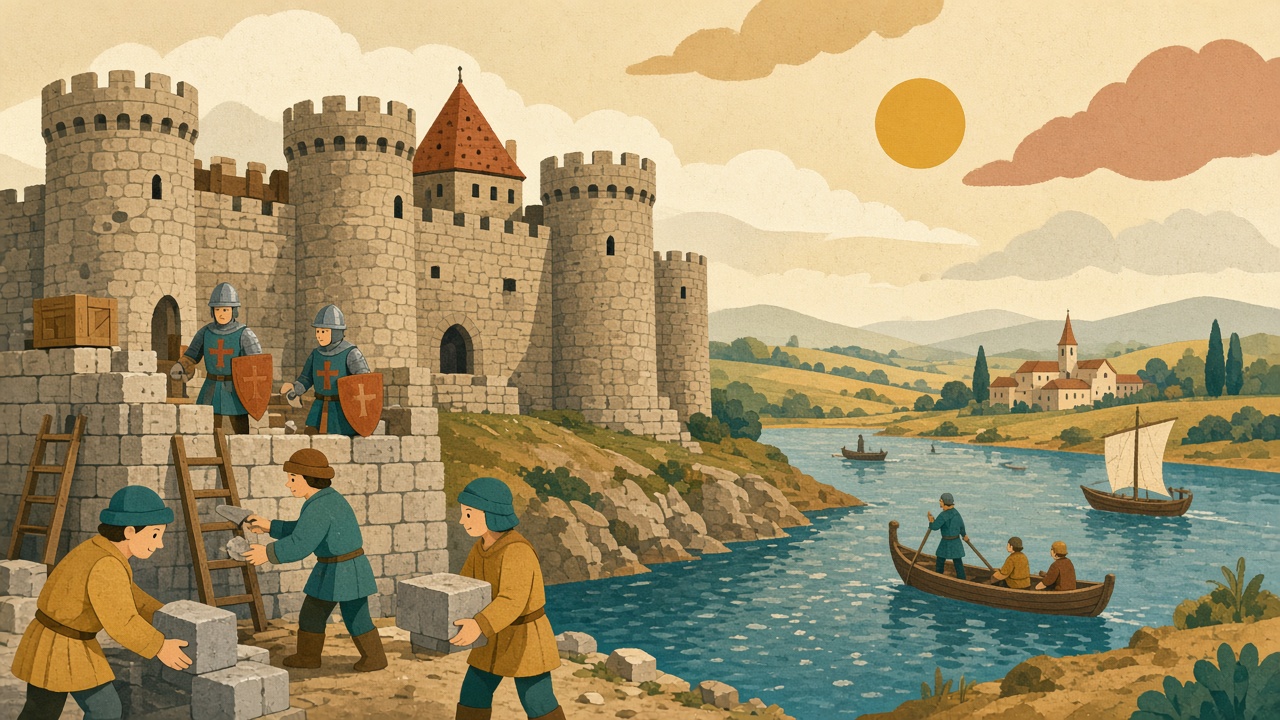
Picture a cold river in the year 1190. Mist on the water, the clank of tools, and a king who is about to ride away to war. Philippe Auguste, King of France, is preparing to leave on crusade, and he will not leave his capital unguarded. So Paris gets a wall, and at the western end of that wall, beside the Seine, rises a fortress with a great round keep at its heart. Its name is the Louvre. Eight hundred years later, you are standing in the most visited museum on Earth, and that fortress has not entirely disappeared. Go down to the lower level of the Sully wing, to the rooms called the Medieval Louvre, and you can walk along the floor of the old moat, the original stone towering beside you. Look closely at the blocks. Some carry small carved signs, a cross, a heart, a little mark of a man. They are believed to be masons' marks, signatures left by workers whose names are otherwise lost. The fortress did not stay a fortress for long. In the fourteenth century, King Charles the Fifth turned it into a royal residence, with a library and painted rooms. In the sixteenth century, Francis the First, a king who adored Italian art, tore down the old keep and began a palace in the new Renaissance style. And so began a habit that would last for centuries: each ruler adding a wing, a facade, a courtyard, until the Louvre stretched along the river like a stone city of its own. Stand here for a moment and listen to the quiet. These walls have heard soldiers, kings and scholars. But they have not yet heard what will truly change their fate: the footsteps of ordinary people walking in through the front door. How did a royal palace become a home for the public? For that, the kings must leave, a revolution must come, and an emperor must arrive with wagons full of treasure.
Chapter 2: From Palace to People's Museum
You are standing in the Grand Gallery. Let your eyes travel down its length, nearly a quarter of a mile of painted walls and soft light. Kings once walked this corridor between their palaces, dry beneath the roof while the rain fell on Paris. In 1682, Louis the Fourteenth, the Sun King, moved his court to Versailles. The Louvre, so long the beating heart of royal power, fell strangely silent. But it did not stay empty. Academies of painting and sculpture took up residence in its halls, and artists set up studios and even homes inside the old palace. Canvases dried where courtiers had once gossiped. Then came 1789, and the Revolution. The royal collections, gathered over centuries for the pleasure of kings, were declared the property of the nation. On the tenth of August 1793, the Louvre opened its doors as a public museum. A shoemaker could stand before the same masterpieces as a duke. It was a quiet revolution inside a loud one. A few years later, Napoleon Bonaparte rose to power, and with his conquering armies came something else: art. Wagons rolled into Paris carrying paintings and statues taken from Italy, from the German lands, from across Europe. The museum was even renamed in his honor, the Musee Napoleon. But empires fall. After his final defeat in 1815, many of those works were returned to their homes, though not all, and that question still echoes today. As you walk, do not hurry toward the end of the gallery. Look at the Italian masters on these walls. Many visitors pass them without a glance, eyes fixed on a single famous face waiting in a room beyond. For nearly two centuries, the museum grew and grew, until it could barely breathe. Its entrances were hidden, its crowds were swelling, and France needed a bold idea. The idea, when it came, was made of glass, and half of Paris would rise up against it.
Chapter 3: The Pyramid Fight
Imagine Paris in the 1980s. President Francois Mitterrand launches a grand plan to remake the Louvre, and he chooses an architect named I. M. Pei, born in China, trained in America. Pei studies the palace, its courtyards, its crowds, and proposes something no one expects: dig deep beneath the courtyard, build a great hall underground, and crown it with a pyramid of glass. The reaction was thunderous. Critics called it a desecration, a gadget, an alien object dropped in front of a royal palace. Petitions circulated. Newspapers sharpened their pens. Pei would later remember that, in those years, strangers glared at him in the streets of Paris. But Pei held his course. He wanted light to pour down into the vast hall where you may now be standing, and he wanted the glass to be clear, so the old palace would still be seen through it. Engineers worked to create panes of unusual transparency. The pyramid opened in 1989, and slowly, the city's anger turned into something else. Affection. Today it is one of the most photographed shapes in Paris. You may hear a whisper that the pyramid holds exactly six hundred and sixty-six panes, the number of the beast. It is a legend, nothing more. The museum's own count is about six hundred and seventy-three. And beneath the shopping arcade nearby, a smaller pyramid hangs upside down, pointing toward the floor, a detail that mystery novelists have found irresistible. Step outside at dusk, if you can. When the lights come on inside the glass, the pyramid seems to glow from within, like a lantern set down among the palaces. And now, let us leave glass behind for marble. Two goddesses wait for us, ancient, broken and astonishing. One was found by a farmer turning over his field. The other was dragged from the earth in pieces by a diplomat who had no idea what he had discovered.
Chapter 4: Two Goddesses Missing a Few Parts
In the spring of 1820, on the Greek island of Melos, a farmer was working his land when his tools struck stone. Out of the earth, in pieces, came a woman carved in marble, calm, half draped, her body turned in a gentle spiral. She was most likely Aphrodite, goddess of love, made around the second century before Christ. Word spread fast. French naval officers took an interest, negotiations followed, and before long she was a gift to King Louis the Eighteenth, who gave her to the Louvre. Her arms were never found. For two centuries, people have imagined them: holding an apple, a mirror, a shield, a strand of her own hair. Perhaps it is the absence that holds us. She asks a question and never answers it. Now walk to the Daru staircase and lift your eyes. At the top, on the prow of a stone warship, stands the Winged Victory of Samothrace. In 1863 a French consul named Charles Champoiseau, digging on the island of Samothrace, uncovered her in fragments. No head. No arms. Yet look at her. Her wings are thrown back, her robes are pressed against her body by a wind that blew more than two thousand years ago. You can almost feel the salt spray. Close by, in a small case, rests a marble hand discovered later at the site, believed to be hers. A goddess, reunited with a single hand across the centuries. Climb the stairs slowly. The statue is placed so that, as you rise, she seems to move toward you, as if she has just alighted on the ship and the battle is already won. Two goddesses of marble, two mysteries of missing pieces. But the most famous face in this building is not carved. It is painted, on a small panel of poplar wood. And a little over a century ago, on a quiet Monday morning, that face disappeared.
Chapter 5: The Day the Mona Lisa Vanished
The room is full of murmurs and raised phones. Behind thick glass hangs a portrait smaller than most visitors expect: the Mona Lisa, painted by Leonardo da Vinci in the early sixteenth century. For centuries she was admired by connoisseurs. But she was not yet a legend. That changed on a Monday in August 1911. The museum was closed. A man named Vincenzo Peruggia, an Italian craftsman who had once worked at the Louvre fitting glass over paintings, moved through the galleries in a white smock, looking like any other worker. According to the most familiar account, he had hidden inside overnight. He lifted the painting from the wall, removed its frame in a quiet stairwell, slipped the panel beneath his clothes, and walked out into the Paris morning. No one noticed for more than a day. When the alarm was finally raised, the news shook the world. The Louvre closed its doors. Police questioned suspects across the city, among them the poet Guillaume Apollinaire and a young painter named Pablo Picasso. Both were released. And when the museum reopened, crowds came to stand before the four empty hooks on the wall, gazing at the space where she had been. For more than two years, she lay hidden in Peruggia's small room in Paris. Then, in 1913, he carried her to Florence and offered her to an art dealer. The dealer called the authorities. Peruggia claimed he had wanted to return her to Italy. The Mona Lisa returned to Paris, and she returned famous, a face known everywhere. When you have seen her, turn around. Behind you hangs the largest painting in the Louvre, and most people never notice it. And while you look, remember this: the Louvre's story of thieves did not end in 1911. On an autumn morning in 2025, it would be written again, with a ladder, a truck and a crown dropped on the ground.
Chapter 6: Giants, Crowns, and Your Escape Plan
Turn your back on the most famous face in the world, and you face a feast. The Wedding at Cana, painted by Paolo Veronese in 1563, stretches nearly ten meters wide, the largest painting in the museum. More than a hundred guests crowd its banquet, and among the musicians, scholars believe, are portraits of Venetian painters themselves. All day long, the Mona Lisa watches this party. Nearby, the great French canvases rise like walls of history. The Coronation of Napoleon by Jacques-Louis David, in which the emperor crowns Josephine, and in which his mother sits proudly in the gallery, though she was, by most accounts, not there at all. Liberty Leading the People by Eugene Delacroix. The Raft of the Medusa by Theodore Gericault, born from a real and terrible shipwreck. And now, the newest chapter. On the morning of Sunday the nineteenth of October 2025, while visitors were already inside, thieves drew up a truck fitted with a mechanical ladder beneath the Apollo Gallery. They rose to a window, forced their way in, broke open cases of the French crown jewels, and within minutes were gone on scooters. Eight treasures vanished. A ninth, the crown of Empress Eugenie, fell during their flight and was found, damaged, outside. Arrests came in the weeks that followed, but at the time of our latest research, the stolen jewels had not been publicly recovered. The story is not yet finished. Visit the Apollo Gallery if it is open, for its golden ceiling alone, a hall that inspired the Hall of Mirrors at Versailles. Before you go: book a timed ticket, arrive early or on an evening opening, and remember the museum closes on Tuesdays. Choose a handful of treasures, not a hundred. And take a moment, somewhere quiet, to remember that all of this began as a fortress by a river. Thank you for walking with me. Another city, and another story, is waiting.
Funny tone · 10:33 · voice: en-US-AndrewNeural
Chapter 1: A Fortress Under Your Feet
Okay, quick question before we start. What do the Mona Lisa, a medieval moat, and a getaway truck with a ladder on it have in common? They're all in this guide. Hi, I'm your funny friend for the next twelve minutes, and we're doing the Louvre the fun way: six short stops, zero art-history homework. So. You're standing in the most visited museum on the planet. Millions of people a year. But it did not start as a museum. It started as a fortress. Around the year 1190, King Philippe Auguste of France was about to leave on a crusade, and he was a little nervous about leaving Paris unguarded. So he built a big wall around the city, and on the western edge, right next to the river Seine, he put up a castle with a fat round tower in the middle. That castle was the first Louvre. Here's the cool part. You can still see it. Down on the lower level of the Sully wing, there's a section called the Medieval Louvre, where you walk along the bottom of the old moat, right next to the original stone walls. Look closely and you'll spot little symbols carved into the blocks. Those are thought to be marks left by the stonemasons, sort of like a medieval time sheet. Somebody was getting paid per block, and they wanted credit. Later kings found the fortress a bit, let's say, drafty. In the 1300s King Charles the Fifth turned it into a fancier home, and in the 1500s King Francis the First knocked down the big old tower and started building a Renaissance palace instead. Every king after that added a wing, and the thing just kept growing, like a house where nobody ever says no to a renovation. So now you've got the biggest palace in Paris, full of royals. Which raises a question. How did the royals end up moving out, and how did regular people like you and me end up moving in? That's a story with a revolution in it. Next stop.
Chapter 2: From Palace to People's Museum
Welcome to the Grand Gallery. Look down this corridor. Long, right? It's roughly a quarter of a mile. Kings once used it to walk from the palace to the Tuileries without getting rained on, which is the most royal sentence I'll say all day. So here's what happened to the royals. In 1682 King Louis the Fourteenth, the Sun King, moved his court out to Versailles. The Louvre basically became the world's fanciest empty apartment. Who moved in? Artists. The royal academies of painting and sculpture set up shop here, and some artists actually lived in the building. Imagine your landlord is the King of France, and he's never home. Then came the French Revolution. In 1793, the revolutionary government decided the royal art collection belonged to the people now. On the tenth of August 1793, the Louvre opened as a public museum. Anyone could walk in. That was a pretty radical idea at the time. And then Napoleon arrived, and things got, um, acquisitive. As his armies marched across Europe, art marched back to Paris. Paintings, statues, you name it. For a while the place was even renamed the Musee Napoleon. Modest guy. After Napoleon was defeated in 1815, a lot of those pieces were sent back to the countries they came from, though not every single one, and historians still talk about that. Here's a tip while you're in this gallery: don't just speed-walk to the famous lady at the end. Slow down and look at the Italian paintings along the walls. Some of them are by the same painters people line up for an hour to see, and here nobody's even blocking your view. Now, for about two hundred years after it opened, the Louvre had a problem. The entrance was confusing, the crowds were growing, and the palace was bursting at the seams. Someone suggested a fix. It was made of glass. And Paris hated it. Let's go find out why.
Chapter 3: The Pyramid Fight
Okay, you came in through, or at least walked past, the glass pyramid. Now picture Paris in the mid 1980s, and someone announces: we're putting a giant glass pyramid in the courtyard of the royal palace. People lost their minds. The architect was I. M. Pei, a Chinese-born American architect, picked by French President Francois Mitterrand for a huge project called the Grand Louvre. The museum needed a real main entrance, plus space underground for tickets, storage, restaurants and all the boring but important stuff. Pei's answer was to dig down and put a glass pyramid on top, so light would pour into the hall below, where you might be standing right now. The newspapers were brutal. Critics said it would look like an alien spaceship had parked in front of a palace. There were petitions. Some people called it an insult to French history. Pei later said that in those years, people would sometimes give him dirty looks in the street. Imagine being the most hated man in Paris because of a triangle. The pyramid opened in 1989, and then, plot twist, people kind of loved it. Today it's one of the most photographed things in the city. If you want the classic photo where you pinch the top of the pyramid with your fingers, go outside to the courtyard and walk back a bit. Everybody does it. Nobody's judging. Well, a little. Fun fact you'll hear around Paris: the pyramid supposedly has six hundred and sixty-six glass panes, the number of the beast. That's a myth. The official count is around six hundred and seventy-three. Close, but less spooky. And underneath the courtyard there's an upside-down pyramid in the shopping area, which some fans of a certain mystery novel get very excited about. Alright, enough glass. Let's go see some marble. Two of the most famous statues in the world are waiting for you, and between them they're missing at least three arms and two heads. Let's go count.
Chapter 4: Two Goddesses Missing a Few Parts
First, the Venus de Milo, in the Sully wing. She's a marble goddess, probably Aphrodite, made in ancient Greece around the second century B.C. And she's famous for what she doesn't have. Arms. Here's how she got here. In 1820, on the Greek island of Melos, a farmer was digging in his field and found her, in pieces, buried among old ruins. French naval officers heard about it, there was some fast negotiating, a little drama about who owned what, and she ended up as a gift to King Louis the Eighteenth, who gave her to the Louvre. The arms were never found. People have spent two hundred years guessing what she was doing with them. Holding an apple? A mirror? A shield? Fixing her hair? Nobody knows, and honestly, that mystery is half the fun. Now head to the big staircase called the Daru staircase, and look up. That's the Winged Victory of Samothrace. She's standing on the front of a stone ship, wings spread, like she just landed on it in a storm. She was found in 1863 on the island of Samothrace by a French diplomat and amateur archaeologist named Charles Champoiseau. No head, no arms, but look at the way the marble clothes ripple, like they're wet and wind-blown. That's carved stone. Somebody did that with a chisel more than two thousand years ago. Here's a bonus. Nearby there's a display case with a stone hand found later at the site, believed to be one of hers. So she's got one hand back. Progress. Quick tip: stand at the bottom of the stairs, then walk up slowly. The statue is placed so she seems to come toward you. Museum designers know how to make an entrance. Now. You've seen the two most famous ladies made of marble. Time for the most famous lady made of paint. And you might be surprised to hear that a hundred and fifteen years ago, she wasn't that famous at all. Then somebody stole her.
Chapter 5: The Day the Mona Lisa Vanished
Welcome to the room where everyone's holding a phone in the air. Behind the glass, behind the crowd, is the Mona Lisa, painted by Leonardo da Vinci in the early fifteen hundreds. She's small. About thirty inches tall. People are always surprised. Here's the thing. Before 1911, the Mona Lisa was respected, but she wasn't a global celebrity. Then, on a Monday in August 1911, when the museum was closed, a man named Vincenzo Peruggia walked out with her. Peruggia was an Italian handyman who had actually worked at the Louvre, helping put protective glass on paintings. According to the usual telling, he hid inside the museum, put on a white worker's smock so he blended in, took the painting off the wall, removed the frame in a stairwell, tucked it under his clothes, and strolled out. And the best part? Nobody noticed for about a day. Guards figured she was being photographed. When people finally realized, it was huge news. The Louvre closed for a week. Police even questioned the poet Guillaume Apollinaire and the painter Pablo Picasso. Yes, that Picasso. Both were cleared. And then crowds came to the Louvre to stare at the empty spot on the wall. People lined up to look at nothing. That's when you know you're famous. Peruggia kept the painting in his little Paris room for over two years. In 1913 he took it to Florence and tried to sell it to an art dealer, who called the police. Peruggia said he wanted to return her to Italy. He got a fairly short sentence, and the Mona Lisa came home to Paris a superstar. Tip: you don't need to fight to the front. Look for a gap at the side, take your photo, then turn around, because the biggest painting in the whole museum is right behind you, and almost nobody looks at it. And speaking of thieves, the Louvre has had a much more recent one. In October 2025, a gang went for the crown jewels. With a ladder truck. In broad daylight. Last stop.
Chapter 6: Giants, Crowns, and Your Escape Plan
Okay, turn around from the Mona Lisa. That enormous painting is The Wedding at Cana by Paolo Veronese, from 1563. It's the largest painting in the Louvre, about thirty-two feet wide, with well over a hundred people at a party, including musicians who are thought to be portraits of Venetian painters. The Mona Lisa is literally staring at it all day. Nearby rooms have the giant French paintings: The Coronation of Napoleon by Jacques-Louis David, where Napoleon crowns his wife Josephine himself, and where his mother appears in the painting even though, by most accounts, she didn't attend. There's Liberty Leading the People by Eugene Delacroix, and The Raft of the Medusa by Theodore Gericault, based on a real shipwreck. Huge, dramatic, and great for photos. Now, the heist. On the morning of Sunday the nineteenth of October 2025, with the museum open, thieves parked a truck with an extendable ladder lift under the Apollo Gallery, climbed up, cut into a window, and smashed display cases holding French crown jewels. They were in and out in a few minutes and escaped on scooters. Eight pieces were taken. One more, the crown of Empress Eugenie, was dropped during the escape and recovered, damaged. Arrests followed in the weeks after, but as of the latest reports we checked, the stolen jewels had not been publicly recovered. So, if you see a tiara at a yard sale, maybe make a call. The Apollo Gallery itself is a golden, painted hall that inspired the Hall of Mirrors at Versailles, and it's worth seeing for the ceiling alone. Your escape plan, legal version: book a timed ticket online, come early or on a late-opening evening, and remember the Louvre is closed on Tuesdays. Pick three or four things, not forty. And if your feet hurt, go sit with the Venus. She's not going anywhere. She can't. No arms. That's the Louvre. Thanks for hanging out with me. See you at the next city.
Family 7+ tone · 11:13 · voice: en-US-AvaNeural
Chapter 1: A Fortress Under Your Feet
Hey explorers! Ready for a mission? Today we're visiting the Louvre in Paris, the most visited museum in the whole world. And your mission is to find a castle, two statues with missing arms, the world's most famous painting, and a crime scene. Sound good? Let's go! First question. What do you think the Louvre was before it was a museum? A school? A zoo? A giant bakery? Nope. It was a castle! A real fortress with thick walls and a moat. About eight hundred years ago, around the year 1190, a king named Philippe Auguste was going away on a long journey to fight in a war. He wanted to keep Paris safe while he was gone, so he built a big wall around the city and a fortress right here next to the river. In the middle was a giant round tower. And here's something amazing. You can still see part of that castle today! Go down to the lower floor of the Sully wing, to the part called the Medieval Louvre. You'll walk along the bottom of the old moat, next to the real stone walls. Mission time: look closely at the stones. Can you spot tiny shapes carved into them, like little hearts or crosses? Experts think those were made by the builders, kind of like signing their name. Count how many you can find! After a while, kings decided they wanted to live here, not just guard things. So they made the castle fancier and fancier. One king, Francis the First, even knocked down the big tower and started building a beautiful palace instead. Every king after him added more rooms, until it was enormous. So now there's a giant palace full of kings and queens. But wait. How did it turn into a museum where anybody, even kids like you, can walk in? Here's a clue: the kings moved out, and the people moved in. Let's find out how!
Chapter 2: From Palace to People's Museum
Welcome to the Grand Gallery! Look how long this hallway is. It's almost as long as four soccer fields lined up in a row. Kings used to walk along it so they could get from one palace to another without getting wet in the rain. About three hundred and fifty years ago, a king named Louis the Fourteenth, who called himself the Sun King, decided to move his whole royal court to a new palace outside Paris, called Versailles. So who used the Louvre after that? Artists! Painters and sculptors had workshops here, and some even lived inside. Imagine living in a palace and painting all day. Not bad, right? Then something huge happened in France. A revolution. The people decided that the king's paintings and statues should belong to everyone. So on the tenth of August 1793, the Louvre opened as a museum for the public. That means everybody was allowed in, not just rich and royal people. That was a brand new idea back then. A little later, a famous leader named Napoleon took over. His armies went to lots of other countries, and they brought back lots of art to Paris. Some of it was taken without asking, which isn't very fair, is it? After Napoleon lost his last big battle in 1815, many of those works of art were sent back home. Mission time! As you walk through this gallery, find a painting with an animal in it. Any animal. A dog, a horse, a lamb, even a bird. When you find one, give it a silly name. Then find a painting with a baby in it. There are lots! Now, as the years went by, more and more people wanted to visit the Louvre. It got really crowded, and the entrances were confusing. People got lost. So someone had an idea to fix it. The idea was a shape you learned in school. And at first, lots of grown-ups in Paris really, really didn't like it. Can you guess the shape?
Chapter 3: The Pyramid Fight
Did you guess it? A pyramid! A big pyramid made of glass. You probably saw it when you came in. About forty years ago, the leader of France, President Francois Mitterrand, asked an architect named I. M. Pei to make the Louvre better. An architect is a person who designs buildings. Mister Pei had a clever plan. He said, let's dig a big hall underground, where people can buy tickets and find their way. And on top, let's put a glass pyramid, so sunlight shines down into the hall. But lots of grown-ups were grumpy about it. They said, a glass pyramid in front of an old palace? That's silly! It looks like a spaceship! Some people were so cross that they gave Mister Pei grumpy looks when they saw him on the street. That must have felt pretty bad. But he believed in his idea, and he kept going. The pyramid opened in 1989. And guess what? People started to love it. Now it's one of the most famous sights in all of Paris, and almost everyone takes a picture of it. Mission time! Go outside to the courtyard with a grown-up. Stand back, hold up your hand, and pretend to pinch the top of the pyramid between your fingers. Ask your grown-up to take a photo. It's a classic! Here's a fun fact. Some people say the pyramid has six hundred and sixty-six glass windows. But that's not true! The real number is about six hundred and seventy-three. That's a lot of window cleaning. There's even a little upside-down pyramid inside, near the shops. See if you can find it. It points down toward the floor, like an ice cream cone standing on its head. Now let's go meet two very old statues. They're thousands of years old. They're super famous. And between them, they're missing a lot of body parts. Ready to play detective?
Chapter 4: Two Goddesses Missing a Few Parts
Detectives, meet the Venus de Milo! She's a statue made of marble, which is a kind of stone. She was carved in ancient Greece more than two thousand years ago. And notice anything missing? Yep. Her arms! About two hundred years ago, in 1820, a farmer on a Greek island called Melos was digging in his field, and his shovel hit something hard. It was this statue, broken into pieces! Later she was sent to France and given to the king, who gave her to the Louvre. Her arms were never found. Mission time! What do you think she was doing with her arms? Was she holding an apple? Brushing her hair? Waving hello? Doing a dance? Strike a pose and show your grown-up your best guess. Nobody knows the real answer, so you can't be wrong! Now walk to the big staircase called the Daru staircase. Look up, up, up. That's the Winged Victory of Samothrace! She's standing on the front of a stone ship with her giant wings spread out, like she just flew down from the sky. In 1863, a French man named Charles Champoiseau found her on an island called Samothrace. She was in lots of pieces too, and she has no head and no arms. Oops! But look at her clothes. They look like they're blowing in the wind, right? Can you believe someone made that out of hard stone, with a hammer and chisel, more than two thousand years ago? Amazing! And here's a happy surprise. Near the statue, there's a glass case with a stone hand that was found later. Experts think it's her hand! So she got one hand back. Mission: walk up the stairs slowly and watch her. Does it feel like she's coming toward you? Spooky and cool. Next, we're going to see the most famous painting in the whole world. But a long time ago, someone stole her right off the wall. Want to hear how?
Chapter 5: The Day the Mona Lisa Vanished
Here she is! The Mona Lisa! She was painted by Leonardo da Vinci more than five hundred years ago. Is she smaller than you expected? Lots of people think so. She's about as tall as a big pillow. Now, story time. In 1911, on a Monday when the museum was closed, a man named Vincenzo Peruggia sneaked in. He used to work at the Louvre, so he knew his way around. He wore a white coat like the other workers, so nobody looked twice at him. He took the Mona Lisa off the wall, hid her under his coat, and walked right out the door! And do you know how long it took for people to notice she was missing? More than a whole day! The guards thought someone had taken her away to photograph her. When they realized she was really gone, it was big news all over the world. The police searched everywhere. People even came to the museum just to stare at the empty spot on the wall. Can you imagine paying to look at an empty wall? The Mona Lisa was hidden for over two years. Then, in 1913, the thief took her to Italy and tried to sell her. But the art dealer he talked to was smart and called the police. Caught! The Mona Lisa came home to the Louvre, and now everyone in the world knew her name. Mission time! Look at her eyes. Then take a few steps to the left, and a few steps to the right. Does it feel like she's still looking at you? A lot of people say yes! Now turn around. Behind you is the biggest painting in the whole museum. It's full of people at a giant party. Can you find a dog? Can you find a cat? Look carefully! And guess what. The Mona Lisa thief isn't the only robber in this story. Just one year ago, some thieves tried a brand new trick to steal royal crowns and jewels. With a ladder on a truck! Let's go find out.
Chapter 6: Giants, Crowns, and Your Escape Plan
Did you find the dog and cat in that big party painting? It's called The Wedding at Cana, and it was painted by an artist named Paolo Veronese. It's as wide as about six grown-ups lying head to toe! More than a hundred people are in it, eating, playing music and chatting. In the rooms nearby there are more giant paintings. One shows Napoleon putting a crown on his wife Josephine's head. Another shows a brave woman holding a flag, called Liberty Leading the People. Mission: find a painting with a flag in it! Now, the newest robbery. On a Sunday morning in October 2025, while the museum was open, some thieves parked a truck with a long moving ladder outside the Apollo Gallery, a golden room full of royal treasures. They climbed up, got in through a window, and grabbed some crown jewels from the glass cases. Then they zoomed away on scooters. They took eight beautiful pieces. But they were in such a hurry that they dropped a crown that belonged to an empress named Eugenie. It was found on the ground outside. Police caught some people later, but when we made this guide, the stolen jewels still hadn't been found. Stealing is never okay, and it makes things sad for everybody who wants to see them. The Apollo Gallery has a sparkly golden ceiling. If it's open, go look up! Before you go, here are some tips for your grown-ups. Book your tickets online. Come early in the day. And remember that the Louvre is closed on Tuesdays. Kids under eighteen get in free, which is pretty great. Final mission: pick your favorite thing you saw today. The castle walls, the glass pyramid, the statue with no arms, or the Mona Lisa. Tell your grown-up why you picked it. Great job, explorers. You conquered the Louvre! See you on our next adventure in another city.