Senso-ji Temple Audio Guide
Two fishermen, one tiny statue, and Tokyo's oldest temple. Six illustrated chapters, about 12 minutes. Pick your narrator.
Full transcript
Tap any sentence to jump there. Switch tone above to read that version.
Storyteller tone · 12:25 · voice: en-GB-RyanNeural
Chapter 1: The Statue in the Fishing Net
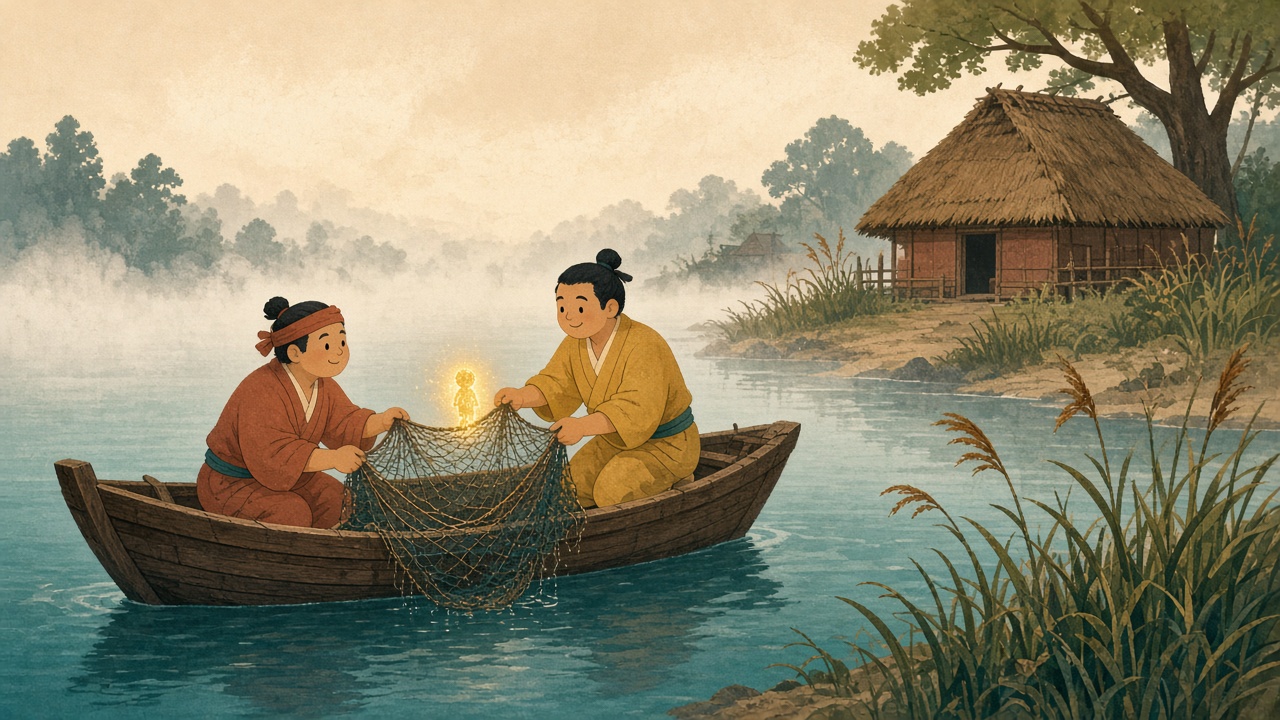
Dawn on a wide river, more than fourteen hundred years ago. Mist lies on the water. Two brothers, Hinokuma Hamanari and Hinokuma Takenari, row out to fish, as they do every morning. They cast their net. They haul it in. And caught in the mesh is not a fish, but a small statue, gleaming, of a figure with a gentle face. The temple dates that morning to the eighteenth of March, in the year 628. The river was the Sumida. The place was a small fishing village called Asakusa, at the edge of a wide, wild plain. Some tellings say the brothers returned the statue to the water, only to find it in their net again. Whether or not that is so, they understood that something extraordinary had come to them. They carried it to their village headman, Haji no Nakatomo. He recognized the figure: Kannon, the bodhisattva of compassion, who hears the cries of the world. Moved, he devoted himself to the Buddhist faith, turned his own home into a temple, and spent the rest of his life in worship of the statue. Seventeen years later, in 645, a priest named Shokai came to the village and built a hall for Kannon. Then, after a revelation in a dream, he made a decision that echoes to this day. The statue would be hidden from human eyes. Remember that. It is the secret at the heart of this place. Over the centuries, the village grew into a city, and the city grew into Edo, and Edo became Tokyo. Shoguns came to pray here, poets and merchants, samurai and farmers. Today, according to the temple, some thirty million people visit each year, all of them, in a way, following two fishermen up from the river. Ahead of you, now, stands a great red gate. A lantern hangs at its center, and in its shadows wait two fierce guardians: one who carries the wind, and one who carries the thunder.
Chapter 2: Wind, Thunder, and a 700 kg Lantern
Stand before Kaminarimon, the Thunder Gate. Its lantern hangs above you, a great red globe nearly four meters high, weighing about seven hundred kilograms, according to Japan's tourism ministry. It sways very slightly in the wind, as if breathing. To one side stands Fujin, god of the wind, a bag of storms slung over his shoulders. To the other, Raijin, god of thunder, ringed by the drums he beats to shake the sky. They were set here to guard the temple from disaster: fire, storm, flood. They are fierce, and they are meant to be. Their fierceness is a kind of protection. Step beneath the lantern and look up. On its base, a dragon is carved, coiled and watchful. Many visitors never notice it. The gate's story is one of loss and return. A gate stood here, in various forms, from the tenth century, and it burned more than once. After a great fire in the 1860s, no permanent gate rose for almost a century. Then, in 1960, Konosuke Matsushita, founder of the company we now know as Panasonic, paid for it to be rebuilt. It is said he had prayed here during an illness, and recovered, and this was his gratitude made visible. On the night of a festival, when the lantern must make way for portable shrines carried through the crowds, it is folded up, like a paper lantern on a summer evening, and raised again when the procession has passed. At night, after the temple closes, the gate is illuminated, glowing in the dark streets of Asakusa. If you can, come at first light, when the gate stands nearly alone, or at night, when it seems to float in its own glow. Now pass beneath the lantern. Before you stretches a narrow street, lined with stalls, alive with the smell of sweet cakes and the chatter of a thousand voices, a street that has welcomed pilgrims for hundreds of years.
Chapter 3: Snack Street
This is Nakamise-dori, the street of shops between the Thunder Gate and the temple. It runs for about two hundred and fifty meters, lined with close to ninety small stalls. The temple counts it among the oldest shopping streets in Japan. Its beginnings, it is said, lie in the Edo period, when local people were permitted to open stalls here in return for keeping the temple grounds clean. Walk slowly. Watch the hands of the sweet-makers pouring batter into iron molds, turning out ningyo-yaki, little cakes filled with sweet red bean paste, shaped like lanterns and pagodas and doves. Look for kaminari okoshi, crisp cakes of puffed rice named for the Thunder Gate, and for age-manju, buns fried until golden and filled with bean paste. The air smells of sugar, soy and warm oil. There is a gentle etiquette here. In Japan, eating while walking is often thought a little impolite, and many stalls ask you to enjoy your treat right where you bought it. So pause. Stand by the stall. Taste. Then walk on. In this way, Nakamise becomes a string of small, unhurried moments. The stalls also sell fans and hairpins, wooden toys and paper charms, little treasures for pilgrims to carry home. For centuries, people have walked this street on their way to pray, and bought something to remember the journey. There are few rubbish bins in Japan, so carry a small bag for wrappers, or ask the stall to take them back. In the middle of the day, the crowds can be dense. Most shops open around mid-morning and close in the early evening. In the very early morning, before the shutters rise, the street is quiet, and you can see the painted scenes on the closed shopfronts. At the end of the street rises a second gate, taller than the first. And on its back hang a pair of sandals so immense that only a giant could wear them.
Chapter 4: Sandals for a Giant
This is Hozomon, the Treasure House Gate. On its upper floor, it holds treasures of the temple, among them precious sutras. The first gate here was raised in the tenth century; the one you see was rebuilt in 1964, a gift from Yonetaro Otani, the founder of the Hotel New Otani. On its front, two mighty guardians stand watch: the Nio, protectors of the Buddhist law. One opens his mouth, one keeps it closed, said to stand for the first and last sounds of the Sanskrit alphabet, the beginning and the end of all things. Now walk around to the back of the gate and look up. Hanging there is a pair of waraji, straw sandals, each about four and a half meters tall. They are woven by the people of Murayama City, in Yamagata Prefecture, far to the north, and offered to the temple. According to the temple, the current pair, given in 2018, is the eighth since 1941, and needed some two and a half tons of straw. Why sandals for a giant? The old belief holds that demons, seeing them, will imagine a guardian of enormous size somewhere inside, and flee. Protection, once again, through a kind of wonder. To the left rises the Five-Story Pagoda, some fifty-three meters tall. The first was built here in 942. The pagoda you see was raised in 1973, after its predecessor was destroyed in the Second World War. According to the temple, it enshrines relics of the Buddha, a gift from a royal temple in Sri Lanka. Look up along its stacked roofs, each one lifting toward the sky like a wing. Stand here for a moment. Around you, prayers are being spoken in quiet voices. Ahead, beyond the gate, lies the Main Hall, and before it, a cloud of fragrant smoke drifts upward from a great bronze vessel. People step into that smoke, gather it in their hands, and draw it over themselves. And nearby, others shake a metal box, waiting to learn their fortune.
Chapter 5: Smoke, Fortunes, and the Secret Statue
Before the Main Hall stands the jokoro, a great bronze incense burner. Pilgrims buy bundles of incense, light them, and set them in the ash. Then they cup the rising smoke in their hands and draw it over their bodies, toward an aching knee, a tired back, a troubled head. The smoke is believed to bring healing and good health. Step into it, and you will smell the faint sweetness that has hung over this place for centuries. Nearby are the omikuji stands. Drop a small coin into the box, a hundred yen at our last check, and shake a metal cylinder until a single numbered stick slips out. Find the matching drawer, and draw out your fortune, written in Japanese and in English. Senso-ji is known for its honesty. It is often said that about three in every ten fortunes here foretell bad luck. If yours is one of them, do not despair. Fold it and tie it to the racks nearby, leaving the misfortune with the temple. If your fortune is good, keep it close. Now climb the steps of the Main Hall and look into the dim interior. Somewhere within, in a miniature shrine sealed with many locks, rests the statue the fishermen drew from the river in 628. According to the temple, since the priest Shokai hid it away in 645, it has never been unveiled, not even to the temple's chief priests. It is a hibutsu, a hidden Buddha. The most treasured image in Tokyo is one that no living person has seen. Its presence is felt, not looked upon. In the ninth century, a revered priest named Ennin carved a likeness of it, so that the faithful might have a glimpse, rarely, of the form they pray to. The temple invites visitors to place their palms together and offer a quiet prayer to Kannon. You may do so, or simply stand in silence. But the hall you stand in is younger than it looks. One night in 1945, fire fell from the sky.
Chapter 6: Fire, Rebirth, and Tokyo at Night
The night of the tenth of March, 1945. American bombers attacked Tokyo with incendiary bombs, in one of the most destructive air raids in history. Fire swept through wooden neighborhoods; across the city, a vast number of people died in a single night. Senso-ji's Main Hall, a national treasure raised by the third Tokugawa shogun, burned. So did the Five-Story Pagoda. Yet the temple rose again. The Main Hall was rebuilt in 1958, paid for by donations from people across Japan, and the pagoda followed in 1973. The new hall is made of concrete and steel, but it keeps the old form: its roof sweeping upward, tall and steep, as if the building itself were lifting its arms. Just to the right of the Main Hall stands Asakusa Shrine, a Shinto shrine that honors, among others, the three men of our story: the two fishermen brothers and the headman who received their statue. Each May, it holds the Sanja Matsuri, one of Tokyo's great festivals, when portable shrines are carried through the streets on the shoulders of shouting, joyful crowds. Look east now, across the Sumida. Rising above the rooftops is Tokyo Skytree, six hundred and thirty-four meters tall, completed in 2012. From this plaza, you can see both at once: a temple whose story began in 628, and a tower of the twenty-first century. Few places hold so many centuries in a single view. For your visit: the temple grounds are free and open at all hours. The Main Hall opens early in the morning and closes around five in the evening. Come at dawn, when locals stop to pray on their way to work, or at night, when the buildings glow against the dark and the crowds have gone. Move gently in the halls, and leave space for those who come to pray. Thank you for walking with me through Senso-ji. The river still flows nearby. In another city, another story waits.
Funny tone · 11:07 · voice: en-US-AndrewNeural
Chapter 1: The Statue in the Fishing Net
Imagine you're a fisherman. You throw your net in the river, you pull it up, and instead of fish, there's a tiny golden statue. You throw it back. You pull up the net again. Same statue. That, according to legend, is how Tokyo's oldest temple began. Hi, I'm your funny friend for the next twelve minutes, and we're doing Senso-ji, in the Asakusa neighborhood of Tokyo, the fun way. So. The year is 628. Tokyo doesn't exist yet. This area is a small fishing village on the Sumida River. Early in the morning, on the eighteenth of March 628, according to the temple's official history, two fishermen brothers, Hinokuma Hamanari and Hinokuma Takenari, pull up their net and find a small statue of Kannon, the Buddhist bodhisattva of compassion. In some versions of the story, they keep throwing it back and it keeps coming back. Very persistent statue. They take it to the village headman, a man named Haji no Nakatomo. He realizes it's a sacred image of Kannon, becomes a devoted Buddhist, and turns his own house into a temple. Imagine coming home and your roommate says, by the way, our living room is a temple now. Seventeen years later, in 645, a monk named Shokai built a proper hall for the statue. And then, after a dream, he decided the statue should be hidden from view. Forever. Hold on to that. It's going to matter later. The temple became incredibly popular over the centuries. Shoguns, samurai, poets and regular people all came to pray here. And today, according to the temple, around thirty million visitors come each year. Thirty million. All because two brothers went fishing. So if you've ever felt like your day job isn't important, remember: two fishermen accidentally founded a top tourist attraction fourteen hundred years ago. Okay, look ahead. You've probably already spotted it: a huge red gate with a gigantic lantern and two very angry-looking guys on either side. One of them controls the wind. The other controls thunder. Let's go say hi. Politely.
Chapter 2: Wind, Thunder, and a 700 kg Lantern
Welcome to Kaminarimon, the Thunder Gate. This is the most photographed spot in Asakusa, and you can see why. That giant red lantern in the middle is about three point nine meters tall and weighs about seven hundred kilograms, according to Japan's tourism ministry. That's roughly the weight of a small car, hanging over everyone's heads. Don't think about it too hard. Now, the two guys in the side niches. On one side, Fujin, the god of wind, carrying a big bag of wind over his shoulders. On the other, Raijin, the god of thunder, surrounded by drums he bangs to make thunder. They're here to guard the temple from natural disasters. Which, honestly, is a smart hire. If you want to stop storms, hire the guys who make them. Look underneath the lantern too. There's a carved dragon on the bottom. Most people walk right past it. You won't, because you're with me. History time. The gate was first built in the tenth century, and it burned down several times over the centuries. After a big fire in the 1860s, there wasn't a permanent gate here for almost a hundred years. Then, in 1960, Konosuke Matsushita, founder of the company that's now Panasonic, paid to rebuild it. The story goes that he had recovered from an illness after praying here and wanted to say thank you. That's a pretty big thank-you card. During the big Sanja festival in May, the lantern gets collapsed so people carrying portable shrines can get through. It folds. Like a giant paper accordion. Tip: early morning or late evening, the gate is way less crowded, and it's lit up at night. Perfect for photos without forty strangers in them. Now walk through the gate. In front of you is a long street of little shops selling snacks, toys and souvenirs. It's one of the oldest shopping streets in Japan, and there are some rules about eating there. Let's go get hungry.
Chapter 3: Snack Street
Welcome to Nakamise-dori, the shopping street that leads from the Thunder Gate to the temple. It's about two hundred and fifty meters long, with close to ninety small shops. The temple calls it one of the oldest shopping streets in Japan. The story is that, back in the 1600s and 1700s, locals were allowed to set up stalls here in return for cleaning the temple grounds. Free rent, you just have to sweep. Fair deal. Okay, snack time. Look for ningyo-yaki, little sponge cakes filled with sweet red bean paste, often shaped like lanterns, pagodas or doves. You can watch them being made in iron molds. Look for kaminari okoshi, crunchy puffed rice crackers, a local Asakusa specialty, named after the Thunder Gate. And age-manju, deep-fried buns filled with sweet bean paste, crispy outside, soft inside. There are also rice crackers, matcha sweets and seasonal treats. Now, the etiquette. In Japan, walking while eating is generally seen as a bit rude, and on Nakamise lots of shops ask you to eat your snack right in front of the stall where you bought it. So buy, stand, munch, and then move on. Think of it as a series of tiny snack parties. Also, watch for the trash situation. Japan has very few public trash cans, so many shops will take back your wrapper. Or keep a little bag in your pocket. You'll look like a pro. Souvenirs here range from cute to wonderfully weird: folding fans, hairpins, little samurai swords made of plastic, wooden toys, and lucky charms. Prices are usually fair, and it's a fun place to pick up gifts. Tip: Nakamise is packed in the middle of the day. Most shops open around nine or ten in the morning and close in the early evening. Early visitors get the best photos, late visitors get the best light. At the end of the street, there's another huge gate. And hanging on the back of it is a pair of sandals so enormous that you'll wonder who on earth is supposed to wear them. That's exactly the point.
Chapter 4: Sandals for a Giant
This is Hozomon, the Treasure House Gate. It's a big two-story gate, and its upper floor actually stores temple treasures, including important sutras. The current gate was rebuilt in 1964 with a donation from a businessman named Yonetaro Otani, founder of the Hotel New Otani. But forget the treasures. Walk around to the back of the gate and look up. Those are waraji, giant straw sandals, each one about four and a half meters tall. They're made by people in Murayama City in Yamagata Prefecture, in northern Japan, and, according to the temple, the current pair arrived in 2018, the eighth pair since 1941. It took about two and a half tons of straw to make. Two and a half tons of straw! So why giant sandals? The idea is this: demons and evil spirits come along, see these sandals, and think, whoa, whoever wears these must be gigantic. Better not mess with this temple. It's basically a supernatural Beware of Dog sign, except the dog is an imaginary giant. On the front of the gate are two muscular guardian statues called Nio, the kings who protect the temple. One has his mouth open, one has his mouth closed. They're often said to represent the first and last sounds of the Sanskrit alphabet, like the beginning and end of everything. Very deep. Also very muscular. Now turn to your left. That's the five-story pagoda, about fifty-three meters tall. The first one was built in 942. This one was rebuilt in 1973, after the old one was destroyed in World War Two. According to the temple, it holds relics of the Buddha given as a gift from a royal temple in Sri Lanka. You can't go in, but you can stare up at it and feel very small. Okay, straight ahead is the Main Hall, and in front of it there's a big bronze pot puffing smoke. People are waving that smoke over themselves on purpose. And nearby, people are shaking metal boxes and getting fortunes. Some of those fortunes are, let's say, not great. Let's go see.
Chapter 5: Smoke, Fortunes, and the Secret Statue
See that big bronze burner in front of the Main Hall? That's the jokoro, the incense burner. People buy a bundle of incense sticks, light them, place them in the burner, and then wave the smoke over themselves. The smoke is believed to bring good health and to heal. Got a sore shoulder? Waft the smoke toward your shoulder. Want to get smarter? Waft it toward your head. I'm not saying it works. I'm saying I always wave a little extra at my head, just in case. Next, the fortunes. These are called omikuji. You put a small coin in the box, a hundred yen at our last check, and shake a metal cylinder until a stick with a number falls out. Then you find the matching drawer and take out your paper fortune. It's in Japanese and English here. Here's the thing. Senso-ji is famous for giving out a lot of bad fortunes. It's often said that roughly three in ten are bad luck. Some temples are kind of nice about it. Senso-ji is your brutally honest friend. If you get a bad fortune, don't panic. Tie it to the metal racks nearby, and the idea is that you leave the bad luck at the temple. If you get a good one, keep it. You're welcome. Now, the Main Hall. Climb the steps and look inside. Somewhere in the inner sanctuary, inside a special miniature shrine, is the original statue that the fishermen found in 628. But here's the twist I mentioned earlier. Nobody sees it. According to the temple, since the monk Shokai hid it in 645, it has never been shown, not even to the head priests. It's a hibutsu, a hidden Buddha. So the most famous statue in Tokyo is one that nobody alive has ever seen. That is next-level mysterious. To pray here, the temple suggests putting your hands together and quietly saying a short prayer to Kannon. But this hall you're standing in isn't very old. In 1945, almost all of it burned down. Last stop.
Chapter 6: Fire, Rebirth, and Tokyo at Night
On the tenth of March, 1945, near the end of World War Two, American bombers attacked Tokyo with firebombs. It was one of the most destructive air raids in history, and huge parts of the city burned in a single night. Senso-ji's Main Hall, a national treasure built under the third Tokugawa shogun, was destroyed. So was the five-story pagoda. But people rebuilt. The Main Hall was rebuilt in 1958 with donations from people all over Japan, and the pagoda in 1973. You can see the new hall is made with concrete and steel, but it's designed to look like the old one, with that dramatic, steep roof. It's a lesson in not giving up, wrapped in a very nice red paint job. Next door, just to the right of the Main Hall, is Asakusa Shrine. That's a Shinto shrine, not a Buddhist temple, and it's dedicated in part to the three men from our story: the two fishermen brothers and the village headman. In May, the shrine holds the Sanja Matsuri, one of Tokyo's biggest and wildest festivals, with huge crowds carrying portable shrines through the streets. Loud, joyful and very sweaty. Now look east, across the river. That super tall tower is Tokyo Skytree, six hundred and thirty-four meters tall, opened in 2012. The view of the old temple with the futuristic tower behind it is very Tokyo: fourteen hundred years and the twenty-first century in one photo. Your game plan: entry to the temple grounds is free. Come early in the morning, when it's calm and locals are praying, or at night, when the buildings are beautifully lit and the crowds are gone. The Main Hall itself opens early and closes around five in the evening. Be respectful in the halls, don't block people praying, and don't forget your Nakamise snack. That's Senso-ji! Thanks for hanging out with me. And hey, if you got a bad fortune today, I hope tying it to the rack did the trick. See you in the next city.
Family 7+ tone · 10:38 · voice: en-US-AvaNeural
Chapter 1: The Statue in the Fishing Net
Hey explorers! Welcome to Senso-ji, the oldest temple in Tokyo, Japan! Your mission today: find a giant lantern, a wind god and a thunder god, giant sandals, a magic smoke pot, and a secret statue that no one is allowed to see. Ready? Let's go! Our story starts a very, very long time ago, in the year 628. That's almost fourteen hundred years ago! Back then, there was no big city of Tokyo. There was just a little fishing village next to a river called the Sumida. One morning, two brothers named Hamanari and Takenari went out fishing in their little boat. They threw their net into the water. When they pulled it up, there weren't any fish inside. Instead, there was a tiny statue! Some people say they threw it back into the river, but when they pulled up the net again, the statue was back! Surprise! The statue was of Kannon. Kannon is a very kind figure in the Buddhist religion, who is all about caring for others and being gentle and helpful. The brothers took the statue to the leader of their village, a man named Haji no Nakatomo. When he saw it, he was amazed. He turned his own house into a temple to take care of the statue. Imagine turning your house into a temple! Mission time! If you found something special in a fishing net, what would you want it to be? A treasure chest? A golden fish? A friendly octopus? Tell your grown-up! Over many, many years, more and more people came to visit. The village grew into a giant city. Today, about thirty million people visit this temple every year, according to the temple. That's a lot of visitors! Now look ahead. Do you see a big red gate with a giant lantern? And on both sides, two scary-looking statues? One is the god of wind, and the other is the god of thunder! Let's go meet them. Don't worry, they're the good guys.
Chapter 2: Wind, Thunder, and a 700 kg Lantern
Welcome to Kaminarimon, which means Thunder Gate! Look up at the giant red lantern. It's about as tall as two grown-ups standing on each other's shoulders, and it weighs about seven hundred kilograms. That's as heavy as a small car! Good thing it's tied on tight. Now, find the two statues on each side of the gate. One is Fujin, the god of wind. He carries a big bag full of wind on his back. When he opens it, whoosh! The wind blows. The other is Raijin, the god of thunder. He has drums all around him, and when he bangs them, boom! Thunder! They look grumpy, but they're actually protecting the temple from storms and other dangers. They're like superhero guards. Mission time! Let's be Fujin! Pretend to open your bag of wind and blow. Whoooosh! Now let's be Raijin! Bang your pretend drums. Boom, boom, boom! Great job! Mission number two: stand right under the lantern and look up at the bottom of it. There's a dragon carved there! Can you find it? This gate burned down a few times in the past. For almost one hundred years, there wasn't a proper gate here at all. Then, in 1960, the man who started a big company called Panasonic gave money to build it again. People say he did it to say thank you, because he got better after being sick. Tip for grown-ups: the gate is less crowded early in the morning or in the evening, and it's lit up at night. Now walk through the gate. In front of you is a long street full of little shops selling yummy snacks and fun toys. But there's a special rule about eating there. Can you guess what it is? Let's go find out!
Chapter 3: Snack Street
Welcome to Nakamise Street! It's a long street, about as long as two and a half soccer fields, with close to ninety little shops. It's one of the oldest shopping streets in Japan. Long ago, people were allowed to open shops here if they helped keep the temple clean. Sweeping for shops. Good deal! Snack time! Here are some yummy treats to look for. Ningyo-yaki are little cakes filled with sweet red bean paste. They're made in metal molds shaped like lanterns, pagodas, and birds. Mission: can you find a shop where they're making them? Watch the batter go into the molds! Then there's kaminari okoshi, crunchy puffed rice treats. And age-manju, round buns that are fried until they're crispy and golden. Now, here's the special rule. In Japan, people usually don't walk and eat at the same time. It's thought to be a little rude. So at Nakamise, you buy your snack, stand next to the shop, and eat it right there. Then you keep walking. Can you remember that? Buy, stop, eat, then go! Another tip: there aren't many trash cans in Japan. So keep a little bag for your wrappers, or ask the shop if they can take them. Mission time! Look at all the shops. Find something red. Find a fan. Find a toy. Find something shaped like a cat. Lucky cat statues, with one paw waving, are very popular in Japan! Tip for grown-ups: the street gets very crowded in the middle of the day. Come early or in the late afternoon for a calmer visit. At the end of the street, there's another giant gate. And hanging on the back of it are the biggest sandals you've ever seen. Who do you think wears sandals that big? Let's go see!
Chapter 4: Sandals for a Giant
This is Hozomon, the Treasure House Gate. It's called that because temple treasures are kept upstairs! On the front, there are two big, strong guardian statues called Nio. Look at their faces. One has his mouth open. One has his mouth closed. Can you copy them? Open your mouth wide like the first one. Now close it tight like the second one! People say they stand for the beginning and the end of everything. Now, walk around to the back of the gate and look up. Whoa! Giant straw sandals! They're called waraji. Each sandal is about four and a half meters tall. That's about as tall as a giraffe! They're woven from straw by people from a city called Murayama, far up in the north of Japan. The temple says the newest pair used two and a half tons of straw. That's a LOT of straw! Why do they hang giant sandals here? It's a clever trick! The idea is that if a bad spirit or monster comes along and sees these huge sandals, it will think: uh oh, a giant must live here! I'd better run away! It's like a sign that says: Beware of the giant! Mission time! Stand under the sandals and compare your feet to them. How many of your feet would fit in one sandal? Guess and tell your grown-up! Now look to the left. See the tall building with five roofs stacked up? That's the five-story pagoda. It's about fifty-three meters tall. That's like a building with about seventeen floors! Count the roofs to make sure there are five. Next, we're going to a big pot that puffs out smoke, where people wave the smoke onto themselves. And we'll try our luck with a fortune. Will you get good luck or bad luck? Let's find out!
Chapter 5: Smoke, Fortunes, and the Secret Statue
Look at the big bronze pot in front of the Main Hall. It's called a jokoro, and it's full of incense. Incense is something that makes a nice-smelling smoke when it burns. People wave the smoke onto their bodies because they believe it helps keep them healthy. If you have a scraped knee, wave smoke to your knee. If you want to do well in school, wave a little toward your head! Mission time! With your grown-up, gently wave a little smoke toward yourself. Where will you wave it? Be careful not to touch the hot incense! Now let's try the fortunes! They're called omikuji. With your grown-up's help, put a coin in the box. Then shake the metal box until a stick with a number falls out. Find the drawer with that number and take out your paper fortune. It's in Japanese and English! Here's something funny. Lots of the fortunes at Senso-ji say bad luck! People say it's about three in every ten. But don't worry! If you get a bad one, you can tie it onto the special racks nearby, and you leave the bad luck behind at the temple. If you get a good one, you can keep it! Now, go up the steps of the Main Hall and peek inside. Remember the tiny statue the fishermen found in the river? It's in there! It's kept inside a special little cabinet with lots of locks. But here's the big secret: nobody gets to see it. Not visitors, not even the most important priests! It's been hidden for almost fourteen hundred years. Isn't that amazing? A super secret statue! Mission: be very quiet inside the hall, because people are praying. If you'd like, put your hands together and make a kind wish for someone you love. Now, the Main Hall looks old, but it's actually not very old at all. A long time ago, during a big war, it burned down. Let's find out how it came back.
Chapter 6: Fire, Rebirth, and Tokyo at Night
During World War Two, in March 1945, Tokyo was attacked with bombs that started big fires. Lots of the city burned, and so did Senso-ji's Main Hall and the pagoda. It was a very sad time, and many people lost their homes. But the people of Japan didn't give up. They worked together and gave money to rebuild their beloved temple. The Main Hall was finished in 1958, and the pagoda in 1973. Look at the Main Hall's roof. See how it's steep and tall? They made it look just like the old one. Right next to the Main Hall is another building called Asakusa Shrine. And guess who it honors? The two fishermen brothers and the village leader from our story! Every year in May, there's a giant festival called Sanja Matsuri, with lots of people carrying little shrines on their shoulders through the streets, shouting and cheering. It's loud and super fun! Mission time! Look out toward the river. Can you see a super tall tower? That's Tokyo Skytree! It's six hundred and thirty-four meters tall. It's one of the tallest towers in the world! Can you take a picture with the temple and the tower together? Tips for your grown-ups: it's free to visit the temple grounds, and they're open all the time. Early morning is quiet and peaceful, and at night the buildings are lit up and look magical. The Main Hall closes around five in the evening. Remember to be respectful and quiet near the halls. Final mission: tell your grown-up your favorite part of today. The fishing net statue, the wind and thunder gods, the snack street, the giant sandals, or your fortune? Great job, explorers! You conquered Senso-ji! See you on our next adventure in another city.